Pondering for Saturday: August 17, 2019

The Remembrance of the Baptisms of Manteo, and Virginia Dare 1587 August 17

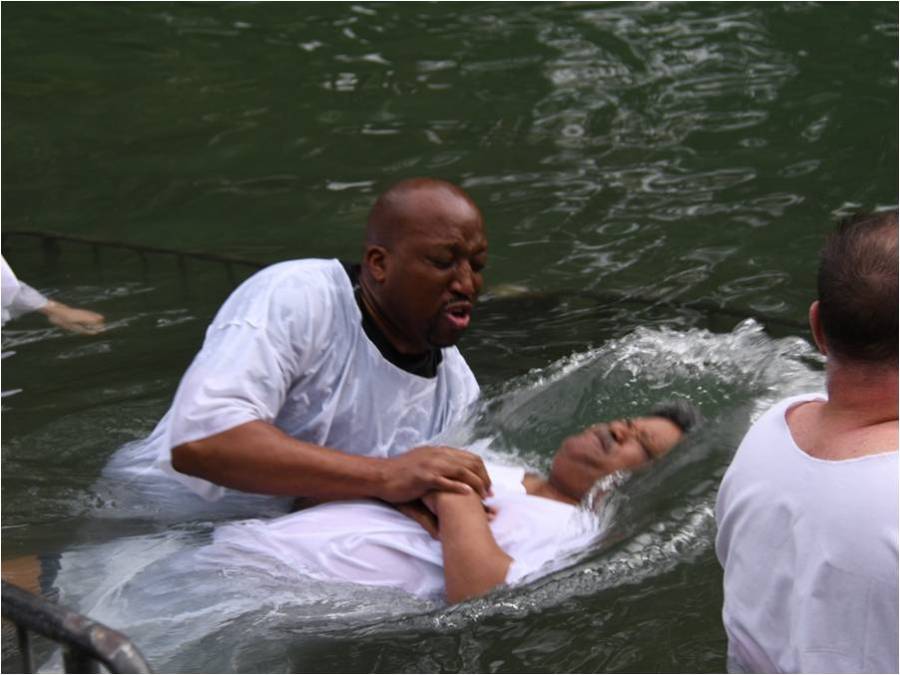
“As they traveled along the road, they came to some water and the eunuch said, “Look, here is water. What can stand in the way of my being baptized?”  (Acts 8:36)

  This is an Icon of the Episcopal Diocese of East Carolina

This is the history of how Baptism from the Church of England came to the Western Hemisphere. It is how God’s hand works on the planet God gave us, this earth, our fragile home.  This is a story about the development of the fetus of the Episcopal Church just over four hundred years ago.

“In the late sixteenth century, Sir Walter Raleigh established three colonies along the northeastern coast of what is now the state of North Carolina. In July 1587, the third and final settlement, consisting of 120 men, women, and children, under the leadership of John White, landed on Roanoke Island, near the present-day community of Nags Head.”  (Great Cloud of Witnesses for August 17)

While the icon shows them together, they were not, and certainly not baptized together. “On August 13, 1587, Manteo was baptized, the first recorded baptism of the Church of England in the American colonies and the first recorded baptism of a Native American person in the Church of England. On August 18, Governor White’s daughter Eleanor and her husband Ananias Dare celebrated the birth of their first child, Virginia. The first child born to English settlers on the North American continent, Virginia’s baptism on August 20 was the second recorded baptism in the Church of England in North America.”  (Great Cloud of Witnesses for August 17)

“Governor White returned to England in late August 1587 to obtain badly needed supplies. It was understood that if the colonists were forced to abandon the settlement in White’s absence, they would carve the name of their destination on a tree. If their departure were due to attack, a Maltese cross would be carved beneath. Delayed by events beyond his control, White was unable to return to the colony for three years. It was not until August 18, 1590, that White finally arrived at the site of the village. White found the word “Croatoan,” with no carved cross or other signs of distress, carved into a post of the fort. Little certainty surrounds the fate of the English settlers, who remain known to history as the “Lost Colony.” (Great Cloud of Witnesses for August 17)  And I might add, while they are lost, they are not forgotten.

While God’s hand is at work at all times in our lives, we too get lost to one another.  But we are not forgotten. What can stand in the way of anyone being baptized,for once done, it is eternal? 

So lets us ponder anew what the Almighty can do.  John+

Pondering for Friday: August 16, 2019

Daily Office Readings for Friday Proper 14 Year 1

AM Psalm 102; PM Psalm 107:1-32 2 Samuel 15:19-37; Acts 21:37-22:16; Mark 10:46-52

“Then Jesus said to him, ‘What do you want me to do for you?’ The blind man said to him, ‘My teacher,let me see again.”   (Mark 10: 51)

Blind Bartimaeus could, at an earlier time, see.  We know this because he asks to see “again.”  He wanted his sight back. Maybe we too could see clearly at one time but somehow got distracted by social events, by faithless peers, by non church nonsense.  We too should ask Jesus if we can see again.  Please Jesus, Son of David, let me see with hope and faith like I used to.

Saul (in Acts) was blinded so that Paul could see! He was given new sight so that he could see what God wanted of him. When we are made to see clearly the love of Christ and how we are able to love more authentically we too become new people. We may not change our names but we are new and different and with new vision.  I have talked to many people who came to the Episcopal Church late in life.  Most of them say they found a spiritual home where they can fully express themselves.  We are not a church of “our way or the highway”; we are a church of Yahweh.

New sight or deeper insight may be the question we might want to ask ourselves.  There have been so many times that I have read passages in the Bible and took off with an idea of what God wanted of me.  And then later in life, I read the same passage and got an entirely new message.  They were the same words but the words said something new to me; it said something deeper, more loving. Both Bartimaeus and Saul/Paul came to Jesus with an undeniable faith. Jesus uses Bartimaeus’ faith to give him back his sight and uses Paul’s faith to put him on the right path.  My sight too is on a continual path of improvement; funny how that works. Our eyesight diminishes as we age but our spiritual sight can improve over time.

The eye of our mind is so important. The ability to see perfection gives us something to strive for.  Similar words were spoken at an ordination I went to some time ago. The newly ordained person said that he heard a famous jazz musician say that “if we can see excellence or perfection, we can aim for it.”   If we can see it, we can attain to it. God is acting in our midst.  We are too often blind to it.  At St Paul’s we use Eucharistic Prayer C during the summer. In that prayer we ask God to “Open our eyes to see your hand at work in the world about us.” (BCP p. 372)  We ask this at Holy Communion so that our eyes might be opened and that we too might see again and with more clarity. Not only do we want to see God’s hand at work in the world but we want to be God’s hand in the world. But, it’s hard to reach out and touch what we cannot see.

So when the world tells you to hush, but then tells you that Jesus heard you and wants you to come to him, what do you want from Jesus?  How about a change of perspective?  Most things in life are dependent on how we see them, glass half full or empty.  As the saying goes, there is always a “bright side” to everything. Jesus can do anything for you but perhaps the best thing to do for you or me is to let us see more clearly through God’s love for us, even a shared love for those who first told you to hush.

Let us ponder anew what the Almighty can do. John+

Pondering for Thursday: August 15, 2019

Daily Office Readings for Thursday Proper 14 Year 1

AM Psalm 105:1-22; PM Psalm 105:23-45 2 Samuel 15:1-18; Acts 21:27-36; Mark 10:32-45

“And they said to him, ‘Grant us to sit, one at your right and one at your left, in your glory.”  (Mark 10: 37)

I must admit that there have been times that I have been self-serving. I think the older I get the less about me I am. But because I have been there I can recognize it in others. I now strive to be community focused in everything I do but it took some pondering.

The lessons in the Gospel and the Old Testament are about people who are trying to secure higher positions for themselves.  In 2 Samuel Absalom did all he could to sway the people to make him king over Israel.    Absalom said moreover, ‘If only I were judge in the land! Then all who had a suit or cause might come to me, and I would give them justice.”  (2 Samuel 15:4)

In our Gospel passage James and John try to advance their status in Jesus’ Kingdom by asking Jesus for places for honor for themselves.  Of course the other ten get angry when they find out what James and John were up to.  As well they should.

We should just be happy in our own stations and if our communities want us to take on more responsibility they should ask us.  I write this as we embark on next year’s elections.  2020 is going to be another record setting year of personal boasting and condemnation of the opponents, on all sides.

In my studies I have found that leaders are sometimes picked by their communities without campaigning.  Two examples that I can think of are the Amish Elders and the Catholic Popes.  Amish Elders come together, as I understand it, when a new elder is needed and cast lots representing elegible men from the community.  And, it is understood that if you are a male member of the community in good standing your name may be drawn.  It’s just the way it is.

Now for the Pope all the Cardinals from around the world gather at the Vatican and they select from among themselves and we then wait for the white smoke.  But again every Cardinal understands that he is eligible to be elected Pope. In this case, there may be some desire on the part of certain cardinals to be Pope but they don’t get there by campaigning for it.

What would life be like if politics in this country were such that we picked from among our communities people we respected without any boasting on their part about wanting to be the leader?  Unlike Absalom, James and John and almost all politicians of our time they brag about how fit they are while belittling rivals. And good money is lost in the mix of pomposity. Maybe as the castors of lots and makers of white smoke, we voters should just do our own homework about who we want to lead and not base it on what folk say about themselves. The more they talk the less they ought.

Let us hear what the Spirit is saying to God’s People.  John+                                                                                                                                                    

Pondering for Wednesday: August 14, 2019

Readings for Jonathan Myrick Daniels (14 August 1965)

Psalm 85:7-13Galatians 3:22-28Luke 1:46-55

“But now that faith has come, we are no longer subject to a disciplinarian, for in Christ Jesus you are all children of God through faith.  As many of you as were baptized into Christ have clothed yourselves with Christ.  There is no longer Jew or Greek, there is no longer slave or free, there is no longer male and female; for all of you are one in Christ Jesus.” (Galatians 3: 25 – 28)

Long ago in my undergraduate studies an anthropology teacher told us that there was no such thing as race, He said further that, if all humans can reproduce with one another we are the same species. He suggested that even to use the term “race” made one a racist.  It took science a long time to get to where Paul was over two thousand years ago.  Jonathan Daniels, whom we remember today also, must have figured that out.

“Jonathan Myrick Daniels was born in Keene, New Hampshire, in 1939. He was shot and killed by an unemployed highway worker in Hayneville, Alabama, August 20, 1965.”  (Great Cloud of Witnesses for August 14) Daniels really lived into the words of Paul to the Galatians where it says “no longer slave or free, there is no longer male and female; for all of you are one in Christ Jesus.”.

Following Jesus is a sacrificial life.  We give ourselves to Jesus for the sake of justice.  Jonathan Daniels was just such a person.  I talk about these kinds of people because they need to be known and remembered.  They did what they did because they were moved by the Holy Spirit to not be afraid and to stand up for justice no matter what.

I always find it amazing when someone can identify the moment they first believed. For me it was years of conversion, not a single incident or a day. But for Daniels, “Like many young adults, from high school in Keene to graduate school at Harvard, Jonathan wrestled with vocation. Attracted to medicine, ordained ministry, law, and writing, he found himself close to a loss of faith when his discernment was clarified by a profound conversion on Easter Day 1962 at the Church of the Advent in Boston. Jonathan then entered the Episcopal Theological School in Cambridge, Massachusetts.” (Great Cloud of Witnesses for August 14)

In March 1965, the televised appeal of Martin Luther King, Jr. to come to Selma to secure for all citizens the right to vote touched Jonathan’s passions for the well-being of others, the Christian witness of the Church, and political justice. His conviction was deepened at Evening Prayer during the singing of the Magnificat: “‘He hath put down the mighty from their seat and hath exalted the humble and meek. He hath filled the hungry with good things.’ I knew that I must go to Selma. The Virgin’s song was to grow more and more dear to me in the weeks ahead.” (Great Cloud of Witnesses for August 14) Again, following Jesus is a sacrificial life.  We give ourselves to Jesus for the sake of justice. 

“After a brief return to Cambridge in May to complete exams, he returned to Alabama to resume his efforts assisting those engaged in the integration struggle. Jailed on August 14 for joining a picket line, Jonathan and his companions resolved to remain together until bail could be posted for all of them, as it was six days later. Released and aware that they were in danger, four of them walked to a small store. As sixteen-year-old Ruby Sales reached the top step of the entrance, a man with a shotgun appeared, cursing her. Jonathan pulled her to one side to shield her from the unexpected threats and was killed instantly by the 12-gauge blast. (Great Cloud of Witnesses for August 14)

Jonathan’s letters and papers bear eloquent witness to the profound effect Selma had upon him. He writes, “The doctrine of the creeds, the enacted faith of the sacraments, were the essential preconditions of the experience itself. The faith with which I went to Selma has not changed: it has grown . . . I began to know in my bones and sinews that I had been truly baptized into the Lord’s death and resurrection . . . with them, the black men and white men, with all life, in him whose Name is above all the names that the races and nations shout . . . We are indelibly and unspeakably one.”  (Great Cloud of Witnesses for August 14)  This testimony and witness of Jonathan Daniels should never be forgotten.  We need to live into Paul’s words; we are all one in Christ Jesus. There is no such thing as race, we are all one and the same, all of us.

Let us hear what the Spirit is saying to God’s people. John+

Pondering for Tuesday: August 13, 2019

Readings for Jeremy Taylor Bishop and Theologian (13 August 1667)

Psalm 139:1-9  Proverbs 7:1-4 Romans 14:7-9,10b-12  Matthew 24:42–47

“We do not live to ourselves, and we do not die to ourselves.  If we live, we live to the Lord, and if we die, we die to the Lord; so then, whether we live or whether we die, we are the Lord’s.  For to this end Christ died and lived again, so that he might be Lord of both the dead and the living.”  (Romans 14: 7 – 9)

 “Jeremy Taylor, one of the most influential of the “Caroline Divines,” was educated at Cambridge and, through the influence of William Laud, became a Fellow of All Souls at Oxford. He was still quite young when he became chaplain to Charles I and, later, during the Civil War, a chaplain in the Royalist army.”  (Great Cloud of Witnesses for August 13)

I find Paul’s words very fitting for the life and legacy of Bishop Jeremy Taylor.  It really brings out the essence of Holy Living and Holy Dying which he wrote.  Jeremy Taylor is also one of my heroes in part because of the way he conducted himself during the take-over of Cromwell and the way Cromwell treated him.

“The successes of Cromwell’s forces brought about Taylor’s imprisonment and, after Cromwell’s victory, Taylor spent several years in forced retirement as chaplain to the family of Lord Carberry in Wales. It was during this time that his most influential works were written, especially Holy Living and Holy Dying (1651).”   (Great Cloud of Witnesses for August 13)

As a bishop Taylor ranks among the greats in my mind.  Among my favorite Bishops are Gregory the Great, Augustine of Canterbury, Anselm of Canterbury, William White our first presiding bishop, Rowan Williams former Arch Bishop of Canterbury, our own Presiding Bishop the Most Reverend Michael Curry, our former Diocesan Bishop Clifton Daniels who ordained me and our current Bishop The Right Reverend Robert Stuart Skirving, Bishop of the Diocese of East Carolina. There is no doubt in my mind that all these bishops have done, and are doing, the will of God as was Jeremy Taylor. Taylor never stopped working hard.

“As Bishop, he labored tirelessly to rebuild churches, restore the use of the Prayer Book, and overcome continuing Puritan opposition. As Vice-chancellor of Trinity College, Dublin, he took a leading part in reviving the intellectual life of the Church of Ireland. He remained to the end a man of prayer and a pastor.”  (Great Cloud of Witnesses for August 13)

The Roman passage above is also read at funerals.  We are God’s possession, alive or dead. Dead is not the end. It is the transformation into a new realm.  Also at funerals is read in the Proper preface, “For to your faithful people, O Lord, life is changed, not ended; and when our mortal body lies in death, there is prepared for us a dwelling place eternal in the heavens.” (BCP p.382) We also learn from Bishop Taylor that it is often in times of deep darkness that our greatest work is done. This is how “Holy Living and Holy Dying” came about. 

Let us hear what the Spirit is saying to God’s people. John+

Pondering for Monday: August 12, 2019

Readings for Florence Nightingale Nurse and Social Reformer, 1910: August 12

Isaiah 58:6-11  Psalm 73:23-29  1 Corinthians 12:4-11  Luke 5:4-11

“Now there are varieties of gifts, but the same Spirit; and there are varieties of services, but the same Lord; and there are varieties of activities, but it is the same God who activates all of them in everyone. To each is given the manifestation of the Spirit for the common good.” (1 Corinthians 12:3 – 7)

Here I go again: Paul nails it.  We all have gifts from God. And our gifts are not for us individually alone, but, as Paul says “the common good.” We each are gifted to share for the health of the whole body of Christ. Today we remember Florence Nightingale.

“Florence Nightingale was born to a wealthy English family in Florence, Italy, on May 12, 1820. She was trained as a nurse in a hospital run by a Lutheran order of Deaconesses at Kaiserwerth (1851) and in 1853 became superintendent of a hospital for invalid women in London. In response to God’s call and animated by a spirit of service, in 1854 she volunteered for duty during the Crimean War and recruited 38 nurses to join her. With them she organized the first modern nursing service in the British field hospitals of Scutari and Balaclava.”  (Great Cloud of Witnesses for August 12)

“Making late-night rounds to check on the welfare of her charges, a hand-held lantern to aid her, the wounded identified her as “The Lady with the Lamp.””  (Great Cloud of Witnesses for August 12)  This maybe why she is remembered with words from Isaiah: “Then your light shall break forth like the dawn, and your healing shall spring up quickly; your vindicator shall go before you, the glory of the Lord shall be your rearguard.”  (Isaiah 58:8)

Like most mystics, Florence had a very prayerful side. “An Anglican, she remained committed to a personal mystical religion, which sustained her through many years of poor health until her death in 1910. Until the end of her life, although her illness prevented her from leaving her home, she continued in frequent spiritual conversation with many prominent church leaders of the day, including the local parish priest, who regularly brought Communion to her. By the time of her death on August 13, 1910, her accomplishments and legacy were widely recognized, and she is honored throughout the world as the founder of the modern profession of nursing.”  (Great Cloud of Witnesses for August 12) This is one of the main reasons I love the Anglican Episcopal path to Christ; we are Word and Table. Contemplation and Communion are so important. In our Baptismal Covenant we promise to continue it the Apostles’ teaching and fellowship, in the breaking of bread and in the prayers.” (BCP p.304)  Florence Nightingale is truly a Saint to emulate. 

Not all of us are gifted to be medical people or musicians or clergy or other such communal paths.  I know people however who have special gifts for nature and math, for science and life. Such a person might even be you. You just need to let go and let God.

So lets us ponder anew what the Almighty can do.  John+

Pondering for Sunday: August 11, 2019

Eucharistic Readings for 9th Sunday after Pentecost Proper 14 Year C Track 2

Genesis 15:1-6 Psalm 33:12-22 Hebrews 11:1-3, 8-16 Luke 12:32-40

“You also must be ready, because the Son of Man will come at an hour when you do not expect him.” (Luke 12:40)

Ok, here is the challenge.  When is it that we do not expect the coming to the Lord?  Being ready is not about preparing for the big day.  It is living everyday as if this day is the day.

If Jesus comes to you next Saturday and ask you when was the last time you prayed what would your answer be?  Would it be “this morning?”  Would it be “last night?”  Would it be last Wednesday at the Healing Service?”  Would it be last Sunday in Church?”  Would it be the last Sunday that you attended a Sunday Service?”  And could it be, “Lord I don’t know?”  No, what we really don’t know is when Jesus will come and ask such a question. And then He’s ready to take us home to that Promised Land that Abraham and Moses looked forward to seeing.

Bishop’s visits are announced.  Our Bishop will visit us next month on the fifteenth of September.  We know that and there is a certain amount of preparation to take place for that event.  But what if Bishop’s visits were unannounced?  “Oh MY God. Look y’all, the Bishop is in the parking lot and coming to our church today!  What are we going to do?”  As Rector here I’ll tell you exactly what we are going to do.  We are going to have church and the Bishop is going to lead and celebrate and I don’t have to worry about whether or not my sermon works or not.

Sometimes we have those unexpected quirks’ that happen at a Sunday service but not everybody is present.  This day and age we will read about such events on social media almost as soon as it happens because phones are active in the pews.  But active phones in the pews won’t relate to you the presence of Jesus should Jesus decide to be at our church on any given Sunday; you know, just to check things out, see whose regular and not just coming when they think he will be here.

Of course I can hear it now, “Man, if I knew Jesus was going to be at our parish today I would have been there.”  Or, “Wow, if I knew Jesus was going to just pop up and ask me the last time I prayed, I would have been praying when he appeared.” Jesus knows that’s what we would say. But that’s not what Jesus is looking for.  Jesus is not looking for you getting ready; Jesus is looking for you being ready. Jesus is not looking for how you want to live your life; Jesus is looking for how you are living your life.

Today’s message is not about tomorrow. It is about now. It is about praying now. It is about looking for Jesus now. It is about expecting Jesus in your life now.  The last thing you want to be texted from the pews is “Jesus came to St Paul’s today and is taking all of us who are here today to Heaven with him.  Sorry you weren’t here.  Love you, bye.” Let’s go the church because it’s Sunday and that’s what we Christians do every week. Like Abraham, we are waiting to go to that Promised Land.  Amen.     

Let us Ponder anew what the Almighty can do.  John+    

Pondering for Saturday: August 10, 2019

Daily Office Readings forSaturday of Proper 13 Year 1

AM Psalm 87, 90; PM Psalm 136  2 Samuel 12:15-31; Acts 20:1-16; Mark 9:30-41

2 Samuel

“But when David saw that his servants were whispering together, he perceived that the child was dead; and David said to his servants, ‘Is the child dead?’ They said, ‘He is dead.’  Then David rose from the ground, washed, anointed himself, and changed his clothes. He went into the house of the Lord, and worshipped; he then went to his own house; and when he asked, they set food before him and he ate.”  (2 Samuel 12: 19-20)

David provides a good example of never giving up.  People often tell me that someone whom I am praying for is at peace and ready to go home.  And, they well may be.  But I hold them in prayer until the minute I hear the diagnosis of death. 

We never know what God might do. We must keep a space open in our hearts for miracles.  God still surprises us and fools doctors.  I have prayed for a young man who was run over by a bus and he lived and is strong to this day.  Many might have thought he might not make it.  But his mother and I and one of the doctors prayed together and God gave him back to us. Thank You Jesus.

I have also prayed for those who God brought home. My mentor priest told me long ago that death was final healing.  The point is that we pray and pray until they begin to get better or they pass on.  If they die, we pick ourselves up, wash our face, freshen up and move on as David did.  Remember, we pray “God’s will be done on earth as in heaven.”  I have a ball cap that reads “PUSH.”  Pray Until Something Happens. David did that.  He prayed to God until God brought his child home. But something did indeed happen.

We don’t have the luxury of having it our way.  We must learn to love it God’s Way. Remember in an earlier post I said, “not my way but Yahweh.” God is communal.  I believe God creates gifts for our communities and wraps these gifts up in a new born human being and causes that human to be born a communal gift.  The rest of us should tirelessly seek to see the gift in the other.  God’s gift can be wrapped in any of assorted skin tones.  The hair bow atop the head can be any texture.  After the gift is born it is enveloped in a human society or environment.  Neither the wrappings nor the environment change or in any way alter the divine gift God placed in the person from the beginning.  So it is always very sad when someone dies but especially so when they never got a chance to use, or express the gifts they brought to us.

Maybe God chose not to let David’s deceit be victorious through a child ill gotten. Instead the divine gift would be expressed in the next child, Solomon.  Every person, infant or elderly, contains a gift from God for the betterment of the community in which they live, or will live and move and have their being. However, when God calls them home we must move on.

Let us then ponder anew what the Almighty is doing. John+

Pondering for Friday: August 9, 2019

Daily Office Readings forFriday of Proper 13 Year 1

AM Psalm 88; PM Psalm 91, 92 2 Samuel 12:1-14; Acts 19:21-41; Mark 9:14-29

“Nathan said to David, ‘You are the man!” (2 Samuel 12:7)

When Nathan tells King David about the rich man who would not slaughter one of his own live stock (of which he had thousands) to feed his guest but took the precious lamb of a poor man who loved his animal as his child, David was furious.  Then Nathan explains that it was metaphorical, and that he (David) was the person who, although he had many wives, took Uriah’s only wife, Bathsheba, and more than that, had Uriah killed.  (2 Samuel 11) Nathan tells David, “You are the man!”  I think David might have needed a moment. David lamented that he did not discipline himself, he did not respect Uriah or Bathsheba, he did not act with integrity, he didn’t seek God’s counsel and he did not give himself time to ponder about what he was doing or about to do.

I have heard stories about me many times. Most of them used my name and were flattering.  However I do remember one person telling a story about a seminary student who had a lapse in judgment without using a name and the details sounded very familiar. I was the man!

Nathan’s story about David’s misdeed was spot on and by not using David’s name (or any name) he caused David to be objective, so objective in fact that as the king with absolute power, he wanted to correct the action as soon as possible. He was not able to see the parallel between himself and the man with many sheep.

We are people of stories.  Can you make up a fictitious story about a real incident by changing the names of some of the players and details but making it just as serious?  I ponder sometimes what skill I might have in telling about a real experience in my life, altering it enough so as to not give away identities but at the same time make it plausible enough to cause people to have an opinion about what happened.

Jesus used metaphor in many of his parables.  They were, and are, great teaching tools. It may be easier to start this exercise by retelling a good story where the protagonist (you) are doing something good. But later let’s take something less flattering and change out your name and tell the story to a friend that does not know the experience and cannot associate it with you.  What is your friend’s reaction?  If it is condemning, remember, “You are the man.”

Nathan was really good at telling his story about David.  We may have to work a bit harder.  But I think if we want good stories about ourselves we must act them out first.  Our lives are real stories.  We are on the world stage.  God is watching.  Act in honest ways with integrity.  I use DRIPP as my guide for decision making. It’s “drip” but with two (p)s.  It is for Discipline, Respect, Integrity, Prayer and Patience. All that David lacked.  If you apply this DRIPP in your life you will be happy to hear your story being told, and take great pride in knowing that, “You are the man or woman.”

Let us ponder anew what the Almighty can do. John+

Pondering for Thursday: August 8, 2019

Readings forDominic Priest and Friar, 1221

Psalm 96:1-7 Romans 10:13-17 John 7:16-18

“So faith comes from what is heard, and what is heard comes through the word of Christ. (Romans 10: 17)

I got into a long discussion in a recent Bible Study (teaching) wherein we talked about how love and faith is taught to our young people.  We all came away with the consensus that both love and faith is taught. (I still hold out that faith is implanted) It is taught via word of mouth with words and with hugs and acts of kindness and forgiveness. The mouth – word part is mouth to ear. It’s preaching and teaching. Saying and doing.

Dominic was the founder of the Order of Preachers, commonly known as Dominicans. In England they were called Black Friars, because of the black mantle they wore over their white habits. Dominic was born circa 1170 in Spain. (Great Cloud of Witnesses for August 8)

Dominic loved preaching.  He preached to everybody but was especially drawn to young minds. He developed preaching in ways that changed some and enhanced the faith of others.

“The continuing Dominican apostolate embraces intellectual work and the arts of preaching, their major houses usually situated in university centers, to which they have contributed such notable teachers as Thomas Aquinas. Their Constitutions express the priority this way: “In the cells, moreover, they can write, read, pray, sleep, and even stay awake at night, if they desire, on account of study.”  (Great Cloud of Witnesses for August 8)

Paul writing to the Romans repeats the Isaiah 52:7 passage that says, “How beautiful are the feet of those who bring good news!” (Romans 10: 15)  This reminds me that the first Christian preachers were on foot.  They had beautiful feet indeed.  They carried the teachings of the Gospel, the Good News, throughout the Roman Empire.  Word of mouth preaching and teaching is still the most effective way of publishing the Good News today around the world in spite of technological advances. We are hardwired to be human to human.

I’m no Dominican but I love teaching and preaching.  Full disclosure, I like teaching the most.  I like the ability converse rather than lecture.  When we converse I can check for understanding as well as learn something new myself.  The Holy One often brings me insight through my so-called students.  I learn from them.   What I have heard from them certainly informs my “implanted” faith and my faith grows more and more as I too listen to, or read from great teachers, in the class or in a book.

I think the problem with society today is that people are falling away from hearing the Good News human to human. The Good News informs us that we are loved by a God who really exist and wants us to love one another human to human and have everlasting life.  We are not to do evil for evil, nor take what belongs to another.  The Good News is that we are “licensed” by Jesus through Baptism to love everybody without having to defend why we love everybody.  We are Christians.  That’s just who we are and what we do.  Thank You Jesus.

Let us hear what the Spirit is saying to (and through) God’s people.  John+