Pondering for Saturday, December 12, 2020

Daily Office Readings for Saturday of the 2nd Week of Advent 2020: Year 1

AM Psalms 30 and 32; PM Psalms 42 and 43;
Isaiah 8:1 to 15; 2nd  Thessalonians 3:6 to 18; Luke 22:31 to 38:

“But I have prayed for you that your own faith may not fail; and you, when once you have turned back, strengthen your brothers” (Luke 22:32)

It seems that our Lord Jesus already knows that Peter will fall away, and he does.  But it seems that Jesus also knows that Peter will come to himself, and return to the Lord, and Peter does that too.

To this point the apostles had been believing primarily on the faith of Jesus.  But Jesus prays that they, and we, will come into our own faith. Jesus tells Peter about Peter’s denial of him three times before the rooster crows. I have heard that rooster crow.  I hear that rooster crow every time I do something that is inconsistent with the teachings of our Lord Jesus. I hear the rooster and look into the eyes of a disappointed, yet loving and forgiving Jesus.

It is my sincere intention to “come to myself.”  I am tired of what that rooster’s crow means to me.  I want to be in a place where I can hear the crow and smile because I will know it no longer applies to my denial of the teachings of Jesus.  How about you?  Have you heard the crow of the rooster?  When you hear it, do you ponder about how you might have done or said something that you would not want our Lord Jesus to witness? 

Come into your own faith. Our Lord Jesus is still praying that we come into our own faith. We will fail from time to time to be who we are created to be.  But it’s not over. We also have the responsibility when we turn back to assist our brothers and sisters with their struggle with the rooster’s crow.  Let’s let that rooster remind us of what we are taught by Lord Jesus, and like Peter, turn our lives around so that the rooster’s crow will be the sound of happiness because we have moved on.

Let us hear what the Spirit is saying to, and through, the saints of God, and then ponder anew what the Almighty can do. John
Pondering for Friday, December 11, 2020

Daily Office Readings for Friday of the 2nd Week of Advent 2020: Year 1

AM Psalm 31; PM Psalm 35;
Isaiah 7:10 to 25; 2nd Thessalonians 2:13 to 3:5; Luke 22:14 to 30

“So then, brothers and sisters, stand firm and hold fast to the traditions that you were taught by us, either by word of mouth or by our letter.” (2nd Thessalonians 2:15)

I did not grow up churched.  I wish I had been. I raised three of my daughters with a Church tradition however; but I still don’t know if it stuck.  At least they have it in their bones if they ever want to revert back to it.  I probably should have done more lecturing about “holding fast” to their tradition. 

I have been a practicing Christian along the Episcopal path since my Baptism at the Easter Vigil of 1980. So I have a little over forty years of ingrained Church tradition.  If you say, “The Lord be with you,” I can’t help but respond, “And also with you.”  It even slips out when I am watching a Star Wars movie and I hear, “The Force be with you.” In a low voice I whisper, “And also with you.”  It has become my tradition.

In Education for Ministry (EfM), we do Theological Reflection. With Theological Reflection we are shown that there are four sources from which all major concerns come.  Of the four sources, Tradition means Christian Tradition which includes our Church, the Bible, Christian music or writings as well as Christian art. Theological Reflection asks us to consider our Tradition when pondering our experiences in life. As Paul says, we must stand firm in our Church traditions as we consider our thoughts and actions.

I was an active duty Marine for 30 years, I have been an active duty Christian now for more than 40 years, fifteen of those forty years as clergy.  I have a lot of ingrained discipline and tradition, and I’m thankful for all of it.

All of us have some kind of life tradition taught to us by parents, or, as in my case, the institutions we joined and grow up in. While I support young people in participating in the military as part of their personal development and as a civic and patriotic duty, I strongly encourage them to become participating and practicing members of a faith community. They should keep up with the passing weeks in their lives not by their days off, but rather, by their meetings with like-minded worshipers on a weekly basis. Church needs to be our tradition and we should hold fast to those traditions that we were taught by parents, pastors and Christian educators.

Let us hear what the Spirit is saying to, and through, the saints of God, and then ponder anew what the Almighty can do. John

Pondering for Thursday, December 10, 2020

Daily Office Readings for Thursday of the 2nd Week of Advent: Year 1

AM Psalm 37:1 to 18; PM Psalm 37:19 to 42;
Isaiah 7:1 to 9; 2 Thessalonians 2:1to 2; Luke 22:11 to 13

“If you do not stand firm in faith, you shall not stand at all.” (Isaiah 7:9)

This is the second half of verse 9 of chapter 7.  But it says everything.  We were created in the  prayers of God to be a people of faith.  God embedded in us the faith connection that informs us about the existence of the Creator. God also gives us the free will to not realize it or live by it.

We may get fairly far in life only counting on our money, physical strength, family connections, political position, or some other human idolatrous anomaly. But all of these can be lost in life.  Some would argue that we could also lose our faith; perhaps, and if so, it is the saddest of all.

 Losing one’s faith will almost certainly cause the loss of at least one of the human attributes; money, health, family or social position. And if faith is lost, where are we when we are called to judgment? And my beloved of the Lord, each and every one of us will be called to judgment.

Belief, moreover, trust and faith in a Power greater than ourselves, who loves us, is the deal breaker in human existence.  We need that faith to keep us going when we find ourselves against the wall and there seems to be no way out.  Our heart screams, “Where are you Lord?” I feel sad for the person who has no faith and yet is in a desperate situation.

We have wonderful examples of Biblical figures who walked by faith.  Abraham, Isaac, Jacob, Moses, Ruth, Esther and Mordecai, and John the Baptist and the apostles of our Lord Jesus, all walked by faith and not by sight, or money, or power, or any human icon of importance. So I like what Isaiah says, “If you do not stand firm in faith, you shall not stand at all.”  Let us listen to this prophet and use our God-given faith, and then walk the rest of this life in faith, in God.

Let us hear what the Spirit is saying to, and through, the saints of God, and then ponder anew what the Almighty can do. John

Pondering for Wednesday, December 9, 2020

Daily Office Readings for Wednesday of the 2nd Week of Advent: Year 1

AM Psalm 38; PM Psalm 119:25 to 48;
Isaiah 6:1 to 13; 2nd  Thessalonians 1:1 to 12; John 7:53 to 8:11

“The scribes and the Pharisees brought a woman who had been caught in adultery; and making her stand before all of them, they said to him, ‘Teacher, this woman was caught in the very act of committing adultery.”  (John 8:3 and 4)

She was not caught alone, she, (and someone else with her), was caught in adultery.  It might have even been one of the men standing in the crowd of scribes and Pharisees with a stone in his hand.  But then our Lord Jesus says to them, “Let anyone among you who is without sin be the first to throw a stone at her.” (John 8: 3 and 4)  They all, one by one, had to deal with their own shortfalls, and walk away. None of us today are without sin.

Twice during this scene Jesus stoops to the ground and writes something. I wish we had what he wrote, if he was writing.  Maybe with his hand touching the ground, his Spirit moved through the ground and touched the conscience of the scribes and Pharisees and elders who were accusing the woman. Therefore, maybe he didn’t even write at all. I ponder these kinds of things. Something shook the men into knowing that they were not innocent of various sins.

Look at what’s going on here.  Jesus reaches down to touch the ground, to write or whatever. The accusing men reach down to pick up a stone. What do we reach down for when something or someone we don’t like comes before us?  Maybe such a time is the time to take notes, with pen and paper, or just a mental note about what is going on in our hearts and minds, and about our own spotty history. We too are still “works in progress.”  Even with our flaws, in Christ Jesus, we are the saints of God. Saints pardon and forgive. Reach down, but be careful about what you pick up.

Let us hear what the Spirit is saying to, and through, the saints of God, and then ponder anew what the Almighty can do. John

Pondering for Tuesday, December 8, 2020

Daily Office Readings for Tuesday of the 2nd  Week of Advent 2020: Year 1

AM Psalms 26 and 28; PM Psalms 36 and 39;
Isaiah 5:13 to 17 and 24 to 25; 1st  Thessalonians 5:12 to 28; Luke 21:29 to 38

“And we urge you, beloved, to admonish the idlers, encourage the faint-hearted, help the weak, be patient with all of them. See that none of you repays evil for evil, but always seek to do good to one another and to all. Rejoice always, pray without ceasing, give thanks in all circumstances; for this is the will of God in Christ Jesus for you.  Do not quench the Spirit. Do not despise the words of prophets, but test everything; hold fast to what is good;” (1St Thessalonians, 5: 14 to 21)

In Paul’s first letter to the Thessalonians he gives them, and us, lessons in how to relate with each other. His instruction requires us to at least notice others; are they idlers, are they faint-hearted, are they weak?  We can’t live in community in a vacuum.  The implied answer to Cain’s question of “Am I my brother’s keeper?” is, yes. (Genesis 4:9)

It is hard to be patient and to rejoice always.  We have sad times.  We can however pray without ceasing.  Such prayer is not formal, spoken prayers, but rather, thoughts of appealing to God for help.  This can, and often should be done, quietly. It is being thankful and saying “Thank You Jesus” when you realize things could have been worse.

Regular reading of scripture certainly helps us in our relationship with others.  As you know, I read our Daily Office daily.  I don’t really get a lot from all of the readings.  But even acknowledging what I don’t like helps.  There is much wisdom in the Bible.  But I advise you to say a little prayer before you read asking the Holy Spirit to assist you with understanding, and then one of thanks at the conclusion. Perhaps a Bible Study group would help.  The prophets still speak to us through these ancient words.

Let us hear what the Spirit is saying to, and through, the saints of God, and then ponder anew what the Almighty can do. John

Pondering for Monday, December 7, 2020

Daily Office Readings for Monday of the Second Week of Advent: Year 1

AM Psalm 25; PM Psalms 9 and 15;
Isaiah 5:8 to 12 and 18 to 23; 1 Thessalonians  5:1 to 11; Luke 21:20 to 28

“All the paths of the Lord are love and faithfulness to those who keep his covenant and his testimonies.” (Psalm 25:9)

Our Presiding Bishop, the Most Reverend Michael Curry, has said of our Church that we are the Episcopal path of the Jesus movement.  I like it!  There are several Christian paths to God.  And just as there are several Christian paths, Christianity is only one of several faith traditions that the people of the world cling to for reconciliation to God.  Judaism and Islam are a couple of other well established faith paths.

Of these three, Judaism is the oldest, and in fact, Christianity has its roots in Judaism. The Psalmist says, “All the paths of the Lord are love and faithfulness to those who keep his covenant and his testimonies.”  Keeping covenant is something we have failed to do over and over again.  The Bible records over and over again how the People of Israel fail to keep covenant with God and then go into repentance and God saves us again.  It makes no difference if covenant is made up of two laws (Love God and love your neighbor), or, if covenant is 613 laws from the Hebrew Testament. We repeatedly fail and must call on God for salvation. Failure requires love and faith.

Love is expressed in all of the three mentioned religious traditions.  There is love of deity and love of fellow human being.  There should be no room for jealousy or hatred within our faith path or of another faith tradition.  We are all God’s children.  And God loves us all the same.  All humanity is favored.  There is no one group within humanity favored over another.

Faith is the other necessary component of a religion.  We must understand that there is a Master of Creation, the Creator and Maintainer.  There is a Presence larger and far more important than ourselves.  It is in this Presence that we place our trust. This trust is for the benefit of life in creation: a creation held together by the love of the Creating Maintainer.

Love and faith make up the Christian covenant (and perhaps others faith covenants) that our Lord Jesus left for us Christians.  We are to love the Lord our God with all that we are.  We are also to trust in the lord in all situations, no matter what.  And the second is like onto it, we are to love our neighbor as our self, (which includes loving ourselves).  Our faith is a path that the Holy One uses to enter our heart.  From our heart, the Holy One spreads love. “All the paths of the Lord are love and faithfulness to those who keep his covenant and his testimonies.”

Let us hear what the Spirit is saying to, and through, the saints of God, and then ponder anew what the Almighty can do. John

Pondering for Sunday, December 6, 2020

Part 1 of 2

Daily Office Readings for Sunday of the Second Week of Advent: Year 1

AM Psalms 148, 149, and150; PM Psalms 114 and 115;
Isaiah  5:1 to 7; 2nd  Peter 3:11 to 18; Luke 7:28 to 35

“So also our beloved brother Paul wrote to you according to the wisdom given to him, speaking of this as he does in all his letters. There are some things in them hard to understand, which the ignorant and unstable twist to their own destruction, as they do the other scriptures.” (2nd Peter 15 and 16)

Rather Christian of Peter to hold up Paul as “beloved brother,” given that the two did not get along very well. But Peter and Paul did agree that Jesus is Lord of all, and so should we also agree.

Part 2 of 2

Isaiah 40:1-11  Psalm 85:1-2, 8-13  2 Peter 3:8-15a  Mark 1:1-8

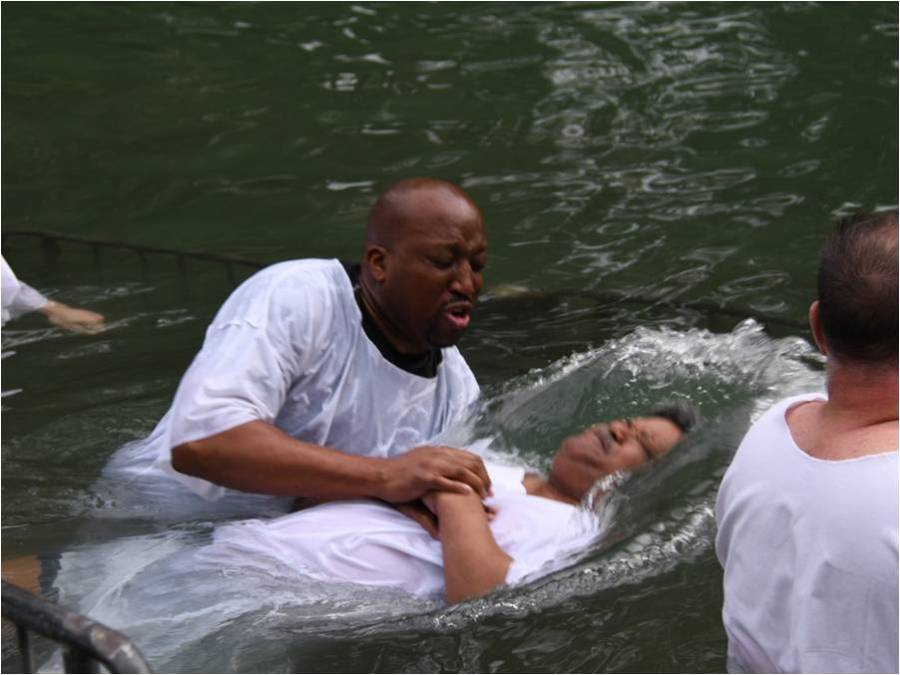
“John the baptizer appeared in the wilderness, proclaiming a baptism of repentance for the forgiveness of sins. And people from the whole Judean countryside and all the people of Jerusalem were going out to him, and were baptized by him in the river Jordan, confessing their sins.” (Mark 1: 4 and 5)

In February of 2018 I was baptized in the River Jordan.  We were all Christian clergy.  I can remember that when it came to be my turn to be among the baptizing ministers, there were more clergy in my line than the others and so my line was the longest line of clergy.  When I inquired why, the response was, that these clergy folk wanted to be able to say that they were baptized in the River Jordan by “John.” 

While I truly believe in one baptism for the remission of sins, This ceremonial baptism in Israel was something I couldn’t pass up.  I enjoyed walking the Holy Land.  But more important was re-living the life that our Lord Jesus experienced.  The God in man who had no sin, was baptized for the remission of sins, our sins. We are so blessed because of Him.  He has planted in us the seed of redemption and will soon come again to harvest his vineyard.

Let us hear what the Spirit is saying to, and through, the saints of God, and then ponder anew what the Almighty can do. John

Pondering for Saturday, December 5, 2020

Daily Office Readings for Saturday of the First Week of Advent: Year 1

AM Psalms 20 and 21:1-7; PM Psalms 110:1-5, 116, and 117;
Isaiah 4:2 to 6; 1 Thessalonians 4:13 to 18; Luke 21:5 to 19

“For since we believe that Jesus died and rose again, even so, through Jesus, God will bring with him those who have died.” (1st Thessalonians 4: 14)

I’m guessing it is our Lord Jesus whom God will bring us to the realm of God.  Jesus, after all, is God’s way of being with us – Emanuel.  It was, and is, a holy time.

For Education for Ministry (EfM) we are reading “Sabbath” by Abraham Joshua Heschel.  The opening words makes us aware that time, and the holy events that take place within time, is more sacred and important than things or places. 

Paul writes from a perspective of immediacy. He believes the Lord’s return will occur within a matter of days. Over time, with the return of the Lord not happening, we who are still waiting, become complacent.  However, we must remember that God does not care about time.  God is outside of time.  We can’t comprehend this concept. Therefore, we must rely on our faith.

We must endure in our faith regardless of the hour, or day, or month, or year.  If we don’t leave our children anything else, we must leave them with the message that the Creator of the universe will return and judgment will take place.  Also our children must be taught that death will not be an escape from judgment.  All will rise.  It will be like when a judge enters a court room, “All Rise.”

Perhaps complacency should be the most dreaded of attitudes.  I battle complacency by having a habit of regular prayer and study; by meditation and communal worship. I am trying very hard to not be caught off guard or surprised when, not if, the Day of the Lord comes.  I encourage all people of faith to also not be surprised when it happens, and not only that, even if we die before the Lord comes in a cosmic way, we need to pass on to those who come after us that such a day will come. It really makes no difference where you are on this planet or in space. Things and places are not as important as preparedness.  The event itself is the most important thing. We must remain vigilant.

Let us hear what the Spirit is saying to, and through, the saints of God, and then ponder anew what the Almighty can do. John

Pondering for Friday, December 4, 2020

Daily office Readings for Wednesday, of the First Week of Advent 2020: Year 1

AM Psalms 16 and 17; PM Psalm 22;
Isaiah 3:8 to 15; 1st Thessalonians 4:1 to 12; Luke 20:41 to 21:4

“Now concerning love of the brothers and sisters, you do not need to have anyone write to you, for you yourselves have been taught by God to love one another; and indeed you do love all the brothers and sisters throughout Macedonia. But we urge you, beloved,  to do so more and more, to aspire to live quietly, to mind your own affairs, and to work with your hands, as we directed you, so that you may behave properly towards outsiders and be dependent on no one.” (1st Thessalonians 4: 9 to 12)

Finally, after Paul is done with ranting about what he perceives as sexual misconduct, he gets to what I believe God really wants us to understand; and that is, that we should contribute to the community in which we live with the work of our hands.

Church is the living example of the benefit of our working with our hands.  The church needs people who are both able and willing to, setup the Altar, play music, cut the grass, fix the broken furniture or structural repairs to the building, prepare food and by all means, make coffee.  Yes, we need workers who perform ministries of working with their hands.  During this pandemic we are asking our ushers to also wipe down the pews with antiseptic cleansers.

From the church, there is always the need for people who must leave home and perform duties that can’t be done at home.  Builders, drivers, store clerks and so forth, must go out into the community and work with their hands in order to hold our community, and outsiders together.  Paul was a tent maker.  He is recorded as plying his trade with a fellow tent maker in order to not be a burden to his host.  (Acts 18: 1 to 3)

Many of us consider ourselves fortunate to be able to work from home.  This type of work normally consists of computer skills that primarily get business done around informational types of work.  Computer work cannot get the ditch dug, or drive supplies to the needed area, or build a house, or prepare a much needed vaccine.  No, we must go out and behave properly towards our community and outsiders and work with our hands as God has directed us through the words of Paul.  What is developed in the heart (good or bad), is made manifest through the works of the hands rather than the words that spill from the mouth.  This is heart to hands folks, and as Larry the Cable Guy would say, Let’s getter done!

Let us hear what the Spirit is saying to, and through, the saints of God, and then ponder anew what the Almighty can do. John

Pondering for Thursday, December 3, 2020

Daily Office Readings for Thursday of Week One of Advent 2020: Year 1

AM Psalm 18:1-20; PM Psalm 18:21-50;
Isaiah 2:12 to 22; 1st  Thessalonians 3:1 to 13; Luke 20:27 to 40

“Indeed they cannot die any more, because they are like angels and are children of God, being children of the resurrection.” (Luke 20:36)

Jesus explains to the Sadducees that marriage is a human construct, not a heavenly one.  I would add that except for Tobit 8: 4 to 8 which is only found in the Apocrypha (if your Bible has one), you will not find marriage vows at all even though there are several places where men took women for wives, in many cases, several women as wives. 

Jesus assures the Sadducees (and us), that there is certainly a resurrection.  We will all be raised before the Host of heaven, the good and the not so good.  Then judgment comes!  A military leader once told me that forewarned is forearmed. I get it.  This means straighten out now before it’s too late.

Jesus uses scripture to show the reality of eternal life as he talks about the exchange between God and Moses at the burning bush. “And the fact that the dead are raised Moses himself showed, in the story about the bush, where he speaks of the Lord as the God of Abraham, the God of Isaac, and the God of Jacob. Now he is God not of the dead, but of the living; for to him all of them are alive.”   (Luke 20:37 and 38)  And this will be us as well; we will be alive in God.  This is not something to try to explain but rather, to prepare for.

Folks, there will be a resurrection for each one of us, and also, for each one of us, there will be judgment. I will again share my personal creed and invite you to create your own statement of belief regardless of your faith tradition. Put it in writing and then revisit it from time to time and see if you are living by it.  Here is my personal creed or statement of belief: (I use “trust” instead of “believe” as I have learned that trust is closer to the original meaning).

“I Trust in the Creating Word through the Holy Spirit of the Incarnate Word, in whom we live and move and love and have our being, and to whom we must give an account.”  You may use my creed as your own if it is true for you as well.

Let us hear what the Spirit is saying to, and through, the saints of God, and then ponder anew what the Almighty can do. John