Pondering for Tuesday, January 21, 2020

Daily Office Readings for Tuesday in the Week of the Second Sunday after the Epiphany: Year 2

Psalm 26, 28; Psalm 36, 39 Gen. 9:1-17; Heb. 5:7-14; John 3:16-21

“As for me, I am establishing my covenant with you and your descendants after you, and with every living creature that is with you, the birds, the domestic animals, and every animal of the earth with you, as many as came out of the ark.”  (Genesis 9: 9 – 10)

I have learned that some of the other faiths also have a flood story. That this Bible story is historically accurate is not so much my concern.  But the lesson here is that we (humans) are the caretakers of the earth and all of its diverse creatures, is what I believe God wants us to know.

This message of caretaker is one that shows up frequently in the Bible as well as in my blog. While we are not God, we have a lot of power in terms of regulating habitats and protecting various species of life, both plant and animal. 

Our spirituality should go beyond how we relate to each other.  It must be seen by God how we relate to this beautiful planet.  This goes beyond the negligent damage we cause with pollution and reckless harvesting of resources.  Yes we need to clean up our act, but more than that, we need to monitor habitats and the eco-systems around the planet to ensure both people and wildlife are in balance with a safe and healthy world.

Here is the truth that goes beyond the flood fact: God is establishing a covenant with us and our descendants after us, and with every living creature that is with us, the birds, the domestic animals, and every animal of the earth with us.

Let us hear what the Spirit is saying to and through the saints of God and then ponder anew what the Almighty can do.  John
Pondering for Monday, January 20, 2020

Daily Office Readings for Monday in the Week of the Second Sunday after the Epiphany: Year 2

Psalm 25; Psalm 9, 15  Gen. 8:6-22; Heb. 4:14-5:6; John 2:23-3:15

“He came to Jesus by night and said to him, ‘Rabbi, we know that you are a teacher who has come from God; for no one can do these signs that you do apart from the presence of God.” (John 3:2)

This is the way we all approach our Lord Jesus, in the darkness of ignorance.  Nicodemus was somewhat condescending in his talk with Jesus knowing that a person cannot re-enter the womb to be born again.  Jesus was explaining a rebirth using metaphor.  This only further explains the dark cloud of ignorance in which Nicodemus found himself.

We do not know how much we do not know.  I am thankful for seminary training. It is not that this religious education made me smart.  Well sort of; it informed me of just how much I had no clue about.  I think knowing how much you don’t know is the beginning of being smart.

But just like the Confession of Peter of two days ago, we don’t figure out God, God shares with us through revelation as it pleases God.  This is a good time to recall a quote from Kallistos Ware: “It is not the task of Christianity to provide easy answers to every question, but to make us progressively aware of a mystery.  God is not so much the object of our knowledge as the cause of our wonder.” (Kallistos Ware)

If Nicodemus believed that our Lord Jesus was a teacher who has come from God because no one can do what our Lord Jesus does apart from the presence of God, then, I say, behave that way Nicodemus!  Instead of challenging Jesus, follow him.  And that goes for us too.

Let us hear what the Spirit is saying to and through the saints of God and then ponder anew what the Almighty can do.  John

Pondering for Sunday, January 19, 2020

Eucharistic Readings for the Second Sunday After Epiphany: Year A

Isaiah 49:1-7  Psalm 40:1-12  1 Corinthians 1:1-9  John 1:29-42

“The next day John again was standing with two of his disciples, and as he watched Jesus walk by, he exclaimed, “Look, here is the Lamb of God!” The two disciples heard him say this, and they followed Jesus.”  (Matthew 1:35 – 39)

They followed Jesus. Our Lord Jesus did not call them, they initiated their own seeking. When we see where our Lord Jesus is in any situation, we too, if we are professed Christians, should use our own initiative and follow Jesus.  They however were not professed Christians.  The Christian path hadn’t started yet.  Andrew, at least, was on the John the Baptist path.

This seems to be the handing off of disciples.  Andrew and the other unnamed disciple of John leave John the Baptist and follow Jesus. This link or connected string of leadership has continued throughout human history, and especially in our Apostolic Christian history.  It is hard to track sometimes, but it’s there none the less in every walk of human evolution.

“When Jesus turned and saw them following, he said to them, “What are you looking for?” They said to him, “Rabbi” (which translated means Teacher), “where are you staying?””  (John 1:38)  It is pointed out here that our Lord Jesus did not ask them “Who” they were looking for. Our Lord Jesus often asks what is it you want me to do for you.  He asked this of James and John; of the blind man, and of others.  For God, the “what” always seems to come before the who.

So what are you looking for?  Utter some word in your heart that describes “what” you are looking for.  Might it be peace?  Might it be love?  Might it be joy? Might it be wealth?  Might it be health? Might it be revenge (you fill in the blank)?  If what you are looking for is not loving, it may not be our Lord Jesus that you want to take the initiative to follow.

But if we are following our Lord Jesus, then why? Are we following our Lord Jesus just to abide with him?  Our Lord Jesus asks a very provocative question, “What are you looking for?”  What do you want me to do for you?  Sometimes we can’t do discernment because we didn’t ask ourselves the right question.  What am I looking for?

Let us hear what the Spirit is saying to and through the saints of God and then ponder anew what the Almighty can do.  John

Pondering for Saturday, January 18, 2020

Today we remember the Confession of the Apostle Simon Peter

Eucharistic Readings for the Confession of St Peter 
Acts 4:8-13Psalm 23; 1 Peter 5:1-4; Matthew 16:13-19

“Simon Peter answered, ‘You are the Messiah, the Son of the living God.” (Matthew 16:16)

The above reading was Peter’s outburst to Jesus asking his followers “Who do you say that I am?”  Peter, in his normal quick responsive self speaks for the group.  Our Lord Jesus responded to Peter, “Blessed are you, Simon son of Jonah! For flesh and blood has not revealed this to you, but my Father in heaven.” (Matthew 16:17)

Maybe this is why our Lord Jesus picked fishermen in the first place. He didn’t want people who studied the paradigm ways of thinking.  He wanted people who were totally dependent on enlightenment from God.

This is very significant for us too.  We do not achieve knowledge about God, it is not earned. We are to live lives of faith following where Jesus leads as Peter and the others did and in God’s own time, God will grace us too with small gifts of understanding only as we can handle it.

Let us hear what the Spirit is saying to and through the saints of God and then ponder anew what the Almighty can do.  John

Pondering for Friday, January 17, 2020

Readings for Antony Abbot in Egypt, 356 January 17

1 Peter 5:6-11  Psalm 91  Mark 10:17-22

“Jesus, looking at him, loved him and said, ‘You lack one thing; go, sell what you own, and give the money* to the poor, and you will have treasure in heaven; then come, follow me.’ When he heard this, he was shocked and went away grieving, for he had many possessions.”  (Mark 10: 21 – 22)

I have often pondered about the rich young man who rejected Jesus’ invitation to “come, follow me.”  He could have had his name mentioned among the apostles.  As it is, I have only seven actual invitees among those named as apostles in spite of the Bible naming twelve. They are, Simon and Andrew – Matthew 4:18 – 20, John and James – Matthew 4: 21 – 22, Matthew (AKA Levi) Matthew 9:9, and then Philip – John 1:43, and Nathaniel – John 1: 50 – 51.  So this rich young man could have been named and among them. Antony, who we remember today, looked at the mistake the rich young man made and changed his way of living.

“In the third century, many young men turned away from the corrupt and decadent society of the time, and went to live in deserts or on mountains, in solitude, fasting, and prayer. Antony of Egypt was an outstanding example of this movement, but he was not merely a recluse. He was a founder of monasticism, and wrote a rule for anchorites.”  (Great Cloud of Witnesses for January 17)

The most important point to note here is that Antony is credited as the founder of Monasticism. While there have been many who built on the idea of monasticism, Antony got it started.

“Antony’s parents were Christians, and he grew up to be quiet, devout, and meditative. When his parents died, he and his younger sister were left to care for a sizable estate. Six months later, in church, he heard the reading about the rich young ruler whom Christ advised to sell all he had and give to the poor. Antony at once gave his land to the villagers and sold most of his goods, giving the proceeds to the poor. Later, after meditating on Christ’s bidding, “Do not be anxious about tomorrow,” he sold what remained of his possessions, placed his sister in a “house of maidens,” and became an anchorite (solitary ascetic).” (Great Cloud of Witnesses for January 17)

If we permit it, Bible stories can change us – improve us.  I use the word “Ponder” because of Luke’s (NRSV translation) explanation of Mary’s Pondering in her heart. “But she was much perplexed by his words and pondered what sort of greeting this might be.” (Luke 1:29) and “But Mary treasured all these words and pondered them in her heart” (Luke 2:19) Mary was no ordinary person. She was handpicked by God to parent the God-child, perhaps because of her loving heart.

Let us hear what the Spirit is saying to and through the saints of God and then ponder anew what the Almighty can do.  John

Pondering for Thursday, January 16, 2020

Daily Office Readings for Thursday in the Week of the First Sunday after the Epiphany: Year 2

Psalm 18:1-20; Psalm 18:21-50 Gen. 4:17-26; Heb. 3:1-11; John 1:43-51

“Therefore, as the Holy Spirit says, ‘Today,  if you hear his voice, do not harden your hearts as in the rebellion, as on the day of testing in the wilderness, where your ancestors put me to the test,  though they had seen my works”  (Hebrews 3:7 – 9)

Today if you hear his voice, don’t harden your hearts.  I think it takes a minute do discern where the internal voice is coming from.  We can call it conscience, or in my case, pondering or whatever.  The point from the Hebrews reading is that we need to at least discern the source of the voice.

I have found that listening deeply requires me to check my emotions.  I have to ask myself how am I feeling.  Am I disturbed about something?  Am I nervous about something?  I must also ask myself if I am overjoyed about anything.  All of these moods or emotions could alter what the Spirit is saying to us.  Such clearing of the mind requires contemplation, meditation and often just sitting quietly alone.  I recall the words of Blaise Pascal who said, “All of humanity’s problems stem from man’s inability to sit quietly in a room alone.  I modified his words to read, “All of humanity’s problems stem from a person’s refusal to sit quietly in a room alone.

Aside from the gender inclusion I want to acknowledge that it is not so much an inability to sit alone but our flat out refusal to do so.  I think this is the hardness of heart that the Holy Spirit warns against.  You should try it.  Sometimes we just need to shut everything off and be still. And yes, know that God is God.(Psalm 46:10)

Let us hear what the Spirit is saying to and through the saints of God and then ponder anew what the Almighty can do.  John

Pondering for Wednesday, January 15, 2020

Today is the Alternative Day to Remember Dr. Martin Luther King Jr.

Readings for Martin Luther King, Jr. Civil Rights Leader and Martyr, 1968

Exodus 3:7-12 Psalm 77:11-20 Luke 6:27-36

“Then the Lord said, ‘I have observed the misery of my people who are in Egypt; I have heard their cry on account of their taskmasters. Indeed, I know their sufferings” (Exodus 3: 7)

In many places in the Bible we can read about stories where God’s ears hears tears.  God finds a way to come to the rescue of people in trouble.  Such was true with Moses going back to Egypt to free his people, the Israelites, from Pharaoh. And such was the case of Dr. Martin Luther King Jr. dedicating his life for the equality of dark skinned people in America. I say “dark skinned” people because I personally don’t believe in “race.”  I think race is a human construct that God laughs at.  God doesn’t believe in race and neither should we.

Dr King was passionate about his call for justice for all people.  It is reported that he once said that “If a man can’t find something he is willing to die for, he is not fit to live.”  Indeed he did die while raising the awareness of underpaid sanitation workers in Memphis, Tennessee regardless of their skin complexion.  This fairness was something he believed in and was willing to die for.

How about us?  What are we willing to die for?  So often the “what” is changed to “who.”  Many of us will proclaim who we are willing to die for, a spouse, a child, a parent or a friend.   But what about an idea, – a concept of freedom, equality and justice for all people?  As Episcopalians we proclaim in our Baptismal Covenant that we “Will strive for justice and peace among all people, and respect the dignity of every human being.” (BCP 305)  I think Dr King lived into what we profess. He did more than just lip service to an old, regularly recited covenant. He was fit to live because he found freedom, liberty and justice for all people as valid reasons to die for.

Let us hear what the Spirit is saying to and through the saints of God and then ponder anew what the Almighty can do.  John

Pondering for Tuesday, January 14, 2020

Readings for Tuesday in the Week of the First Sunday after the Epiphany: Year 2

Psalm 5, 6; Psalm 10, 11 Gen. 3:1-24; Heb. 2:1-10; John 1:19-28

“John answered them, ‘I baptize with water. Among you stands one whom you do not know.”  (John 1: 26)

We don’t always know who is in our midst.  I wonder if John made eye contact with Jesus as he said the words “Among you stands one whom you do not know.”  John knew Jesus, it is said that they were cousins.

Knowing someone is more than just knowing who their relatives are, their parents, siblings and so forth. Knowing a person implies, at some level you know what they like and dislike, what they value and their preferences of foods, music, habits and hobbies.  In the case of our Lord Jesus, it also means you know He is God Incarnate.  No one in the crowd knew that about our Lord Jesus except for Cousin John.

I have been around some of my friends for a very long time only to find out that when a certain issue came up, they surprised me with how they acted.  Then I realized that I didn’t really know them at all.  So when John says “Among you stands one whom you do not know,” he’s right. But let’s not confuse knowing a person with knowing “of” a person.  Sometimes it’s good to know something about a person in order to know how close you want to be with them.  The more similar attitudes you both have about various subjects the closer you become.  But even with this, I like to be close with people who differ with me in some areas.  I always want to hear an opposing view point. It keeps me honest. It may even cause me to shift in my pondering as I hear what the Spirit is saying to me.  We don’t mature if we stay stagnated with people of the same mind.

Let us hear what the Spirit is saying to and through the saints of God and then ponder anew what the Almighty can do.  John

Pondering for Monday, January 13, 2020

Daily Office Readings for Monday in the Week of the First Sunday after the Epiphany: Year 2

Psalm 1, 2, 3; Psalm 4, 7 Gen. 2:4-9(10-15)16-25; Heb. 1:1-14; John 1:1-18

Long ago God spoke to our ancestors in many and various ways by the prophets, but in these last days he has spoken to us by a Son, whom he appointed heir of all things, through whom he also created the worlds.” (Hebrews 1:1-2)

It is perhaps difficult if not impossible for us to wrap our minds around all matter and all life being created through the Property of God we now call our Lord Jesus.  This message is also reflected in John’s Gospel as he writes, “All things came into being through him, and without him not one thing came into being.” (John 1:3).

So God creates and maintains the universe through our Lord Jesus who walked among us to model for us how we should live in creation with one another. I believe we humans have three missions in life. First we are assigned as caretakers of the earth.  Second, we must recognize that we live in covenant relationship with one another for the purpose of being co-maintainers of the earth. And lastly, we are to ever strive to develop and maintain our faithful connection with the Creator, “Our Father in Heaven.”

The more I ponder these things the more focused I am able to be about our call to exist and do the work God has put before us. God has made a Grandfather clock and has put us here to wind it ever so often. Yes, we may use it to mark the time, but we also must keep it running. This clock is not just for ourselves.  The rhythms of the musical chimes are the living pulse of all in the house.   If we don’t keep it going, it will shut down. Let those who have ears listen.

Let us hear what the Spirit is saying to and through the saints of God and then ponder anew what the Almighty can do.  John

Pondering for Sunday, January 12, 2020

Eucharistic Readings for the First Sunday after the Epiphany Year A

Isaiah 42:1-9Psalm 29Acts 10:34-43Matthew 3:13-17

“But Jesus answered him, “Let it be so now; for it is proper for us in this way to fulfill all righteousness.” Then he consented.” (Matthew 3: 15)

So Jesus comes to John to be baptized and John has second thoughts. But Baptism is in many ways like crucifixion, you must be handed over into the hands of others for it to be done to you. One does not baptize one’s self.  It is in this way we are communal.  We need, and must have others in whom we place ourselves. This then, according to our Lord Jesus, fulfills all righteousness.

“And when Jesus had been baptized, just as he came up from the water, suddenly the heavens were opened to him and he saw the Spirit of God descending like a dove and alighting on him.” (Matthew 3: 16) 

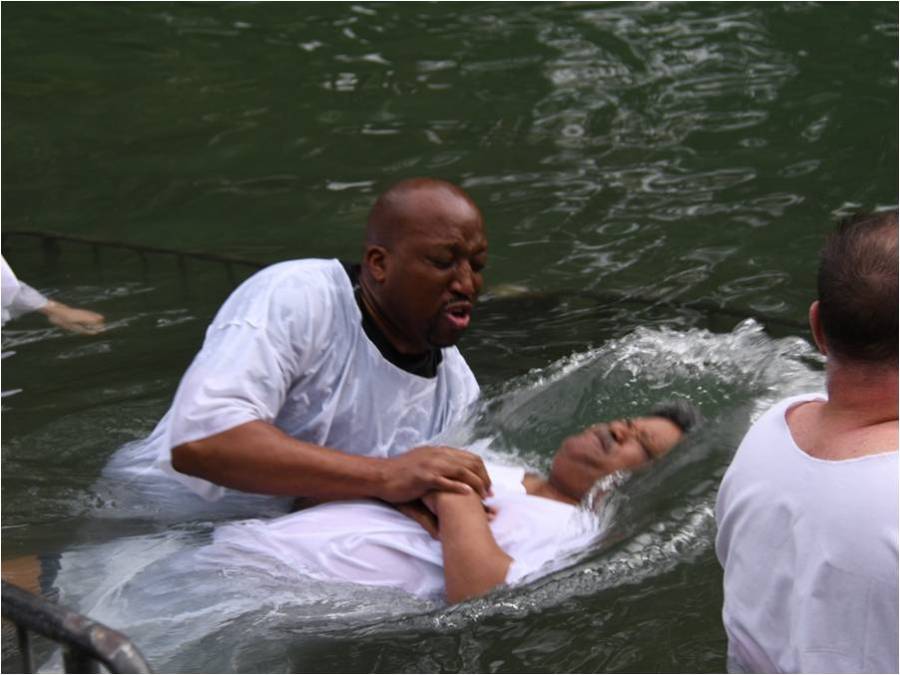
This coming up out of the water has been interpreted in at least two ways.  It could mean that as he was pushed beneath the surface of the water (full emersion) and that his face being brought back above the surface on the way up; or , it could mean as he was stepping back up on the bank, out of the water where he knelt while John took water in his hands and lifted it over Jesus’ head. Either way, baptism is baptism.  My most memorable baptism was also in the Jordan where almost 50 Christian clergy were on tour to the Holy Land.  That water was really cold!

 In Matthew’s Gospel we hear the voice of God speaking to us, “And a voice from heaven said, “This is my Son, the Beloved, with whom I am well pleased.”” (Matthew 3: 17)  The voice doesn’t say “You” as if speaking to Jesus directly.  The voice informs us that this is our Lord Jesus and that God is so pleased with him.

Baptism is one of two Holy Sacraments for Christians, the other being Holy Communion.  In accordance with the Canons of our Church one must be baptized before receiving Communion.  This makes One Baptism for the forgiveness of sins the preeminent sacrament. I personally believe that even after the water stops moving over us, the Holy Spirit continues moving over us always.

Let us hear what the Spirit is saying to and through the saints of God and then ponder anew what the Almighty can do.  John